Engagement Rate
Calculator
What they're saying about us

This podcast is a game-changer! The episodes are packed with actionable insights, and the hosts really know how to keep you engaged. I feel like I’m constantly learning something new.
We’ve been recommending Transistor to everyone we know who’s interested in starting a podcast.

I’ve learned so much from this podcast! Whether it’s business, personal growth, or just having fun, every episode feels like time well spent. The perfect blend of entertainment and knowledge. The hosts make complex topics easy.

I’ve been listening since day one, and it just keeps getting better! The production quality is top-notch, and I always walk away with fresh perspectives.
This podcast has transformed my mornings. The hosts dive deep into topics I care about and offer insights I can apply in my life right away. Highly recommend!
After testing out 20+ podcast hosting platforms and working with numerous clients setting up their hosting, Transistor.FM is the one I always recommend because of its unique features, accessibility and user interface.
After testing out 20+ podcast hosting platforms and working with numerous clients setting up their hosting, Transistor.FM is the one I always recommend because of its unique features, accessibility and user interface.
When people ask me which podcast host I recommend, I say: 'Transistor is 100% the way to go.
I’ve been listening since day one, and it just keeps getting better! The production quality is top-notch, and I always walk away with fresh perspectives.

Follower counts are vanity metrics. Engagement rate is the number that tells you whether your content is actually working.
An engagement rate measures the percentage of your audience that interacts with your content through likes, comments, shares, saves, and bookmarks. A high follower count with a low engagement rate means your content is reaching people but not resonating. A modest following with a high engagement rate means you have an audience that cares about what you say. One of these is worth more than the other, and it is not the one with the bigger number.
This free engagement rate calculator works across all major platforms and compares your performance against real industry benchmarks.
How the engagement rate calculator works
Select your platform, enter your follower count, and add the number of likes, comments, shares, and saves your content received. The calculator divides total interactions by followers and multiplies by 100 to give you a percentage.
That percentage alone does not mean much without context. A 2% engagement rate on Instagram is average, but a 2% engagement rate on TikTok is below average because TikTok content typically generates more interaction per view.
That is why the calculator includes platform-specific benchmarks so you can see exactly where you stand relative to your peers, not just relative to an arbitrary number.
What is a good engagement rate?
Engagement benchmarks vary significantly across platforms because each platform has different content formats, audience behaviors, and algorithmic distribution models.
On Instagram, an engagement rate above 6% is considered excellent. Between 3% and 6% is good. Between 1% and 3% is average, and anything below 1% suggests your content is not connecting with your audience.
On LinkedIn, the benchmarks are slightly lower because the platform skews professional and users interact more selectively. An engagement rate above 5% is excellent, 2% to 5% is good, and 1% to 2% is average.
On TikTok, engagement rates are naturally higher because the platform's algorithm pushes content to non-followers. Excellent is above 9%, good is 4.5% to 9%, and average is 2% to 4.5%.
On Facebook, engagement has declined steadily as the platform has shifted toward paid distribution. Excellent is above 3%, good is 1% to 3%, and average is 0.5% to 1%.
YouTube and X fall somewhere in between, with their own distinct patterns based on how each platform surfaces content to audiences.
Why engagement rate matters more than reach
Reach tells you how many people saw your content. Engagement tells you how many people cared enough to do something about it. In a world where algorithms reward interaction over impressions, engagement rate is the signal that determines whether your content gets distributed further or dies in the feed.
For B2B teams in particular, engagement rate is a proxy for audience quality. A post that reaches 10,000 people and gets 50 likes is performing worse than a post that reaches 1,000 people and gets 80 likes. The second post found the right audience. The first post found a big one. These are not the same thing.
High engagement also compounds over time. Platforms learn which content performs well and show more of it. Every post that generates above-average engagement trains the algorithm to give your next post a better starting position. Low engagement does the opposite — it teaches the algorithm to deprioritize your content.
How to improve a low engagement rate
If your engagement rate is below average, the problem is almost always one of three things: content-audience mismatch, inconsistent posting, or low visibility.
Content-audience mismatch means you are creating content for who you think your audience is rather than who they actually are. Look at your top three best-performing posts and identify what they have in common. That is what your audience wants more of, regardless of what you planned to create.
Inconsistent posting breaks the algorithmic feedback loop. If you post three times one week and then disappear for two weeks, the platform stops prioritizing your content. Consistency matters more than volume. Three posts a week, every week, outperforms ten posts one week and zero the next.
Low visibility means your content is not reaching enough people to generate interaction. This is usually a distribution problem, not a content problem. Are you posting at optimal times for your audience? Are you engaging with other accounts to trigger reciprocal visibility? Are you using platform-specific features like carousels, polls, or video that the algorithm tends to favor?
Using engagement data to inform your content strategy
Engagement rate is most valuable when tracked over time, not as a single snapshot. Calculate your engagement rate weekly or monthly and look for trends. Are certain content formats consistently outperforming others? Do posts on specific topics generate more comments while others generate more shares? Is your engagement rate climbing, flat, or declining?
These patterns tell you what to double down on and what to stop doing. They also reveal opportunities that raw reach numbers hide. A post with low reach but high engagement is a signal that the topic resonates deeply with a small audience. That might be your highest-value content even though the vanity metrics look underwhelming.
The best-performing teams connect their engagement data to their broader marketing system so they can see how social interaction maps to website traffic, lead generation, and pipeline. Engagement without attribution is interesting. Engagement tied to revenue is actionable.
Who this calculator is for
This engagement rate calculator is built for marketing managers, social media leads, founders, and anyone responsible for content performance who wants a quick benchmark without logging into five different analytics dashboards. Enter your numbers, see where you stand, and get a clear recommendation for what to do next.
Pipes Before Chocolate
How to build an AI-augmented go-to-market engine with a skeleton crew, content, sales outbound, inbound, ABM, and thought leadership, without a 15-person team or a six-figure tool budget.
Download for Free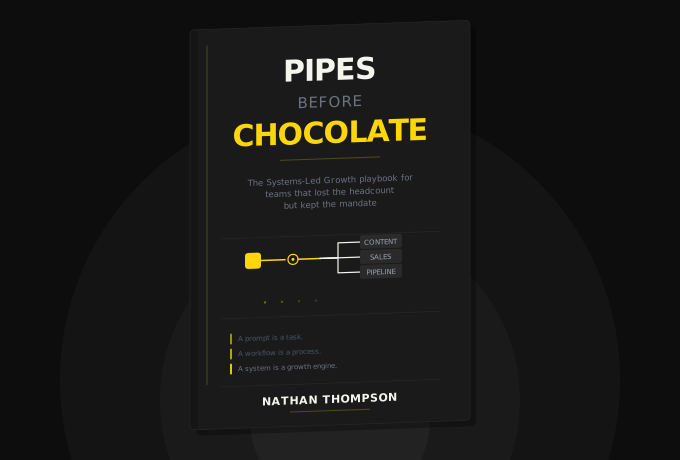

Frequently Asked Questions
A weekly podcast where real SaaS operators share the AI workflows they've built to survive skeleton-crew life. No thought leadership or sponsored hot takes. My goal in each episode is to focus on what's actually working.
Get notified every time we post an new episode
Lorem ipsum dolor sit amet, consectetur adipiscing elit.