Statement of Operating Procedure
(SOP) Template
What they're saying about us

This podcast is a game-changer! The episodes are packed with actionable insights, and the hosts really know how to keep you engaged. I feel like I’m constantly learning something new.
We’ve been recommending Transistor to everyone we know who’s interested in starting a podcast.

I’ve learned so much from this podcast! Whether it’s business, personal growth, or just having fun, every episode feels like time well spent. The perfect blend of entertainment and knowledge. The hosts make complex topics easy.

I’ve been listening since day one, and it just keeps getting better! The production quality is top-notch, and I always walk away with fresh perspectives.
This podcast has transformed my mornings. The hosts dive deep into topics I care about and offer insights I can apply in my life right away. Highly recommend!
After testing out 20+ podcast hosting platforms and working with numerous clients setting up their hosting, Transistor.FM is the one I always recommend because of its unique features, accessibility and user interface.
After testing out 20+ podcast hosting platforms and working with numerous clients setting up their hosting, Transistor.FM is the one I always recommend because of its unique features, accessibility and user interface.
When people ask me which podcast host I recommend, I say: 'Transistor is 100% the way to go.
I’ve been listening since day one, and it just keeps getting better! The production quality is top-notch, and I always walk away with fresh perspectives.

A standard operating procedure is the difference between a process that works when you are in the room and a process that works when you are not. Every team has processes that live in someone's head. SOPs get them out of that head and into a document that anyone can follow, regardless of whether the person who designed the process is available.
The problem is that writing SOPs is tedious. Most teams know they need them but never prioritize creating them because the process of documenting a process feels like bureaucratic overhead. So the knowledge stays locked in people's heads, new hires take months to ramp, and every vacation creates a bottleneck.
This free SOP template generator removes the friction. Enter your process details, add your steps, and get a properly formatted standard operating procedure document you can copy and share with your team immediately.
How the SOP template generator works
Enter the process name, department, process owner, and the purpose of the SOP. Optionally list the tools and resources needed to execute the process. Then add each step with a title, description, responsible person or role, and estimated time. The generator assembles everything into a clean, professional SOP document with numbered steps, role assignments, time estimates, and a total time calculation.
You get two output formats. HTML is what you paste into your internal wiki, Notion, Confluence, or company intranet. Plain text is what you paste into Google Docs, Slack, or email when you need to share it quickly.
What is a standard operating procedure
A standard operating procedure is a documented set of step-by-step instructions that describe how to complete a specific process. SOPs exist to ensure consistency, reduce errors, accelerate training, and make processes repeatable regardless of who is executing them.
Good SOPs share three characteristics. They are specific enough that someone unfamiliar with the process can follow them. They assign clear ownership so everyone knows who is responsible for each step. And they include enough context about why each step matters that the person following the SOP can make good judgment calls when edge cases arise.
What should an SOP include
Every SOP should include a clear process name, the department or team it belongs to, the process owner who is responsible for maintaining it, a version number for tracking changes, an effective date, a purpose statement explaining why the process exists, a list of tools and resources needed, and the step-by-step procedure itself.
Each step should have a title that summarizes the action, a description with enough detail to execute without ambiguity, the person or role responsible for that step, and an estimated time so the team can plan their workload. Including time estimates also makes it easier to identify which steps are taking longer than expected and where the process might need optimization.
SOP template vs process documentation vs playbook
These terms are often used interchangeably but they serve different purposes. An SOP is a step-by-step instruction set for one specific process. It answers "how do I do this exact thing" with precise, actionable steps.
Process documentation is broader. It describes how a system or function works, including the inputs, outputs, dependencies, and exceptions. It answers "how does this part of the business operate" rather than "how do I complete this task."
A playbook is a collection of SOPs, guidelines, frameworks, and best practices organized around a function or role. A marketing playbook might contain SOPs for publishing blog posts, launching campaigns, and running events, along with brand guidelines, audience personas, and channel strategies. The SOP is one component within the playbook.
How to write a good SOP
Start with the outcome. Before writing any steps, clearly define what a successfully completed process looks like. If you cannot describe the end state in one sentence, the process is either too complex for a single SOP or not well enough understood to document yet.
Write for someone who has never done this before. The most common mistake in SOP writing is assuming the reader has context they do not have. If a step requires logging into a specific tool, say which tool and where to find it. If a step requires a judgment call, explain the criteria for making that call. If a step references a template, link to the template.
Keep each step to one action. A step that says "research keywords, write the outline, and draft the introduction" is actually three steps. Break them apart. Each step should describe exactly one thing the person needs to do before moving to the next step.
Include the why, not just the what. Steps that explain their purpose are followed more consistently than steps that do not. "Add alt text to every image" is less compelling than "add alt text to every image so the page is accessible and the images can be indexed by search engines." People skip steps they do not understand. They follow steps that make sense to them.
How often should SOPs be updated
Review every SOP at least once per quarter. Processes change more often than people realize and outdated SOPs are worse than no SOPs because they create false confidence. A team member following an outdated SOP will do the wrong thing with certainty, which is harder to catch than someone who asks for help because they have no documentation.
Beyond quarterly reviews, update an SOP immediately any time the process changes — when a tool is replaced, a step is added or removed, a role changes, or a mistake reveals a gap in the documentation. The process owner listed on the SOP is responsible for keeping it current.
Common SOP mistakes
The most common mistake is writing SOPs that are too long. If an SOP is more than 15 steps, the process is probably complex enough to break into two or three separate SOPs that reference each other. A 30-step SOP is a document that nobody will read past step five.
The second mistake is writing SOPs that are too vague. Steps like "ensure quality" or "review as needed" are not instructions. They are aspirations. Every step should be concrete enough that two different people would execute it the same way.
The third mistake is creating SOPs and never using them. An SOP that lives in a folder nobody opens is wasted effort. SOPs should be referenced during onboarding, linked in project management tools, and reviewed during process retrospectives. If your team does not know where your SOPs live, they effectively do not exist.
Who this tool is for
This SOP template generator is built for operations managers, team leads, founders, and anyone who needs to document a process without spending an hour formatting a document. It is especially useful for growing teams where processes are changing quickly and documentation needs to keep pace with how the team actually works.
Pipes Before Chocolate
How to build an AI-augmented go-to-market engine with a skeleton crew, content, sales outbound, inbound, ABM, and thought leadership, without a 15-person team or a six-figure tool budget.
Download for Free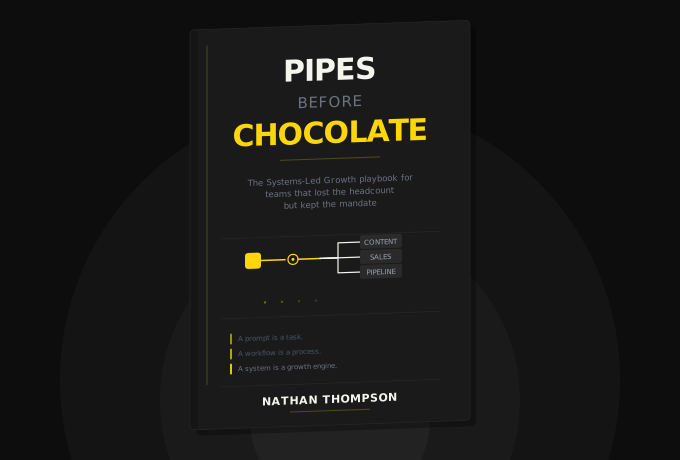

Frequently Asked Questions
A weekly podcast where real SaaS operators share the AI workflows they've built to survive skeleton-crew life. No thought leadership or sponsored hot takes. My goal in each episode is to focus on what's actually working.
Get notified every time we post an new episode
Lorem ipsum dolor sit amet, consectetur adipiscing elit.