Request for Proposal (RFT)
Template
What they're saying about us

This podcast is a game-changer! The episodes are packed with actionable insights, and the hosts really know how to keep you engaged. I feel like I’m constantly learning something new.
We’ve been recommending Transistor to everyone we know who’s interested in starting a podcast.

I’ve learned so much from this podcast! Whether it’s business, personal growth, or just having fun, every episode feels like time well spent. The perfect blend of entertainment and knowledge. The hosts make complex topics easy.

I’ve been listening since day one, and it just keeps getting better! The production quality is top-notch, and I always walk away with fresh perspectives.
This podcast has transformed my mornings. The hosts dive deep into topics I care about and offer insights I can apply in my life right away. Highly recommend!
After testing out 20+ podcast hosting platforms and working with numerous clients setting up their hosting, Transistor.FM is the one I always recommend because of its unique features, accessibility and user interface.
After testing out 20+ podcast hosting platforms and working with numerous clients setting up their hosting, Transistor.FM is the one I always recommend because of its unique features, accessibility and user interface.
When people ask me which podcast host I recommend, I say: 'Transistor is 100% the way to go.
I’ve been listening since day one, and it just keeps getting better! The production quality is top-notch, and I always walk away with fresh perspectives.

A request for proposal is the document that determines whether you get useful, comparable responses from vendors or a pile of generic pitches that all look the same. The difference is almost always the quality of the RFP itself. A vague RFP gets vague proposals. A specific RFP with clear requirements, evaluation criteria, and submission guidelines gets responses you can actually compare and act on.
Most teams hate writing RFPs because they take hours to format and nobody is sure what to include. This free RFP template generator walks you through every section and produces a professional, properly structured request for proposal you can send to vendors immediately.
How the RFP template generator works
Enter your project details: the RFP title, your organization, contact person, issue date, proposal deadline, and optional budget range. Describe your company background, project objectives, and current situation so vendors have the context they need to write a relevant proposal.
Then define your scope of work as a numbered list of specific requirements. Add evaluation criteria with percentage weights so vendors know exactly how their proposals will be scored. Specify your submission requirements and add timeline milestones for the selection process.
The generator produces a formatted RFP document with a professional header, structured sections, numbered requirements, a weighted evaluation criteria table, and a visual timeline. Copy it as HTML for your website or procurement portal, or as plain text for email distribution.
What is a request for proposal
A request for proposal is a formal document that an organization issues when they need to purchase a product or service and want to evaluate multiple vendors before making a decision. The RFP describes what the organization needs, how proposals will be evaluated, and when responses are due. It creates a structured process for vendor selection that is fair, transparent, and efficient.
An RFP is different from an RFQ, which is a request for quotation. An RFQ asks for pricing only and is used when the specifications are already defined. An RFP asks for both a proposed approach and pricing, and is used when the organization wants to understand how different vendors would solve the problem, not just what they would charge.
What should an RFP include
Every RFP should include six core sections. The project overview identifies who is issuing the RFP, who the contact person is, the issue date, the proposal deadline, and optionally the budget range. Including a budget range is controversial but generally helps because it prevents vendors from guessing and either pricing too high or scoping too small.
The background and objectives section gives vendors the context they need to write a relevant proposal. Describe your organization, explain what you are trying to achieve, and share where you are currently. The more specific you are about your current situation and goals, the more tailored the proposals will be.
The scope of work section lists the specific requirements vendors need to address. Each requirement should be concrete and measurable. Instead of writing "provide content marketing services," write "produce 15 SEO-optimized blog articles per week, each 1,200 to 1,800 words, with meta descriptions and FAQ schema markup."
The evaluation criteria section tells vendors exactly how their proposals will be scored. Assign percentage weights to each criterion so vendors know what matters most. Common criteria include relevant experience, proposed approach, team qualifications, pricing, and timeline.
The submission requirements section specifies how to submit, what format to use, and what the proposal must include. Be explicit about required sections like company overview, case studies, team bios, approach, timeline, and pricing breakdown.
The timeline section lists key milestones in the selection process: when the RFP is issued, when questions are due, when proposals are due, when finalist presentations happen, and when the decision will be made.
How to write RFP requirements that get good responses
The most common mistake in RFP writing is requirements that are too vague. When your requirements are unclear, vendors respond with generic capabilities statements instead of specific proposals. You end up comparing boilerplate to boilerplate, which tells you nothing about how each vendor would actually approach your project.
Write each requirement as a specific, measurable deliverable. For each one, a vendor should be able to clearly understand what is being asked and respond with a concrete plan for how they would deliver it. If a requirement could mean different things to different vendors, it is not specific enough.
Include context for why each requirement matters.
Vendors who understand the business objective behind a requirement will propose better solutions than vendors who are just checking boxes. If you need 15 articles per week because you are trying to build topical authority in a competitive space, say that. The vendor's approach will be different than if you need 15 articles per week because you are trying to maintain an existing content calendar.
How to set evaluation criteria
Your evaluation criteria should reflect what actually matters for the success of the project, not what is easiest to measure. Many RFPs over-weight pricing because it is the most objective criterion, but the cheapest vendor is rarely the best vendor for complex services.
A balanced set of criteria for a services RFP might look like: relevant experience and case studies at 25 percent, proposed approach and methodology at 30 percent, team qualifications at 15 percent, pricing at 20 percent, and timeline at 10 percent. Adjust the weights based on what matters most for your specific project.
Share your evaluation criteria in the RFP. Some organizations keep their criteria confidential, believing it prevents vendors from gaming the process. In practice, transparent criteria produce better proposals because vendors know where to focus their effort. A vendor who knows that approach is weighted at 30 percent will spend more time explaining their methodology, which is exactly what you want.
Common RFP mistakes
The most common mistake is making the RFP too long. An RFP that is 40 pages long with dozens of requirements and appendices discourages good vendors from responding because the effort to respond is too high relative to the probability of winning. Keep your RFP focused on what vendors actually need to know to write a good proposal.
The second mistake is not including a budget range. Without a budget, vendors have no idea whether to propose a basic solution or a comprehensive one. You will receive proposals ranging from five thousand to five hundred thousand dollars and waste time evaluating options that were never realistic.
The third mistake is an unrealistic timeline. If you issue an RFP on a Monday and expect responses by Friday, you will only hear from vendors who had a pre-written proposal ready to go. Give vendors at least two to three weeks to respond to a standard RFP and four to six weeks for complex projects.
The fourth mistake is not allowing questions. Include a questions period where vendors can ask for clarification.
The questions vendors ask often reveal whether they understand the project and have relevant experience. Distribute all questions and answers to all participating vendors for fairness.
Who this tool is for
This RFP template generator is built for procurement managers, marketing leaders, operations directors, founders, and anyone who needs to solicit proposals from vendors without spending a day formatting a document. Enter your project details, define your requirements, and have a professional RFP ready to distribute in minutes.
Pipes Before Chocolate
How to build an AI-augmented go-to-market engine with a skeleton crew, content, sales outbound, inbound, ABM, and thought leadership, without a 15-person team or a six-figure tool budget.
Download for Free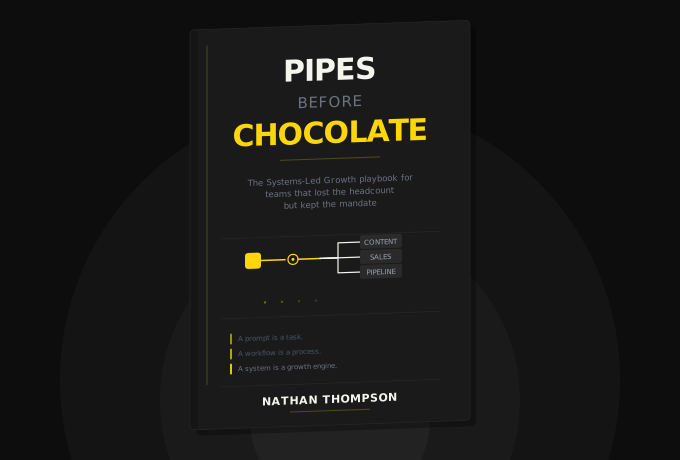

Frequently Asked Questions
A weekly podcast where real SaaS operators share the AI workflows they've built to survive skeleton-crew life. No thought leadership or sponsored hot takes. My goal in each episode is to focus on what's actually working.
Get notified every time we post an new episode
Lorem ipsum dolor sit amet, consectetur adipiscing elit.