Pipeline over Pageviews
An Audit
What they're saying about us

This podcast is a game-changer! The episodes are packed with actionable insights, and the hosts really know how to keep you engaged. I feel like I’m constantly learning something new.
We’ve been recommending Transistor to everyone we know who’s interested in starting a podcast.

I’ve learned so much from this podcast! Whether it’s business, personal growth, or just having fun, every episode feels like time well spent. The perfect blend of entertainment and knowledge. The hosts make complex topics easy.

I’ve been listening since day one, and it just keeps getting better! The production quality is top-notch, and I always walk away with fresh perspectives.
This podcast has transformed my mornings. The hosts dive deep into topics I care about and offer insights I can apply in my life right away. Highly recommend!
After testing out 20+ podcast hosting platforms and working with numerous clients setting up their hosting, Transistor.FM is the one I always recommend because of its unique features, accessibility and user interface.
After testing out 20+ podcast hosting platforms and working with numerous clients setting up their hosting, Transistor.FM is the one I always recommend because of its unique features, accessibility and user interface.
When people ask me which podcast host I recommend, I say: 'Transistor is 100% the way to go.
I’ve been listening since day one, and it just keeps getting better! The production quality is top-notch, and I always walk away with fresh perspectives.

How to Identify What Traffic Drives Revenue and What to Kill
I deliberately killed pages driving tens of thousands of visits because they attracted the wrong people. Traffic went from 350k to 210k monthly visits. Pipeline went from effectively zero to $3-4M.
Most people would look at those traffic numbers and think something went wrong. That decision, choosing pipeline over pageviews, is the foundation of everything I believe about growth.
This is the audit process I use to figure out which content is driving business outcomes and which is just making a dashboard look good.
When Traffic Lies
I want to tell you about the most instructive dashboard I've ever seen.
SEMrush, the SEO analytics platform, reports its own estimated traffic on its own tool. If you looked at it in isolation, it was massive. Millions and millions of visits.
But a huge portion of that traffic was coming from pages about adult content review sites. People Googling things completely unrelated to SEO tools. The visits were real. The audience was meaningless.
SEMrush isn't alone. This pattern is everywhere in B2B SaaS.
A freemium product drives enormous top-of-funnel traffic from people who will never buy. A viral blog post brings 50,000 visitors who have no relation to your ICP. A free tool ranks for a high-volume keyword that attracts students and hobbyists, not the VP of Revenue Operations who's your actual buyer.
Traffic is the easiest metric to game. It's also the easiest to misinterpret.
When I took over content at Copy.ai, I had helped the site was pull about 350,000 organic visits per month. Most of it came from free tools: sentence rewriters, paragraph generators, Instagram caption maker. The kind of tools that attract anyone with a keyboard and a homework assignment. The traffic looked beautiful in Ahrefs. The pipeline chart for enterprise prospects was a flatline.
My job was to fix that.
The Audit: Five Steps
Step 1: Map Every Page to an Audience
Pull your top 100 pages by traffic. For each one, answer one question: who is this page attracting?
Not who you want it to attract. Who it actually attracts. Look at the keyword it ranks for and be honest about who Googles that term.
"Sentence rewriter" attracts students and freelancers. "Revenue operations platform for mid-market SaaS" attracts your buyer. Both might drive traffic. Only one drives pipeline.
Sort every page into one of three buckets:
ICP traffic. The page ranks for a keyword your actual buyer searches. The content addresses a pain point your product solves. The visitor could plausibly become a customer.
Adjacent traffic. The page attracts people who are in your general industry but aren't buyers. They might be useful for brand awareness or domain authority, but they won't convert to pipeline. Think: broad educational content that ranks well but attracts practitioners, not decision-makers.
Wrong traffic. The page attracts people who will never buy your product. Free tools, generic topics, high-volume keywords that have nothing to do with your ICP. This is the traffic that makes dashboards look good and pipeline look empty.
Step 2: Check Conversion Data Against Each Bucket
Pull conversion data for every page in your top 100. Form fills, demo requests, trial signups, whatever your conversion event is.
You'll almost certainly find that a small number of ICP-targeted pages drive the overwhelming majority of conversions, while the high-traffic pages in the "wrong traffic" bucket convert at near zero.
At Copy.ai, the free tool pages drove hundreds of thousands of visits and almost no enterprise demos. The ICP-focused pages drove a fraction of the traffic and nearly all of the pipeline.
If you don't have conversion data at the page level, that's your first problem to solve. Set up goal tracking in your analytics so you can see which pages actually produce business outcomes.
Step 3: Calculate the Real Cost of Wrong Traffic
Wrong traffic isn't free. It costs you in ways that don't show up on a dashboard.
Server and infrastructure costs. Every visitor costs something to serve, even if it's fractions of a cent. At scale, hundreds of thousands of wrong visitors add up.
SEO signal dilution. When a large percentage of your traffic comes from off-ICP pages, your site's topical authority gets muddied. Search engines see you as a "sentence rewriter" site, not a "revenue operations platform" site. That makes it harder for your ICP-focused pages to rank.
Team attention. When traffic is the primary metric, the team optimizes for traffic. Every hour spent maintaining, updating, or creating content for wrong-traffic pages is an hour not spent on pipeline-driving content.
Brand perception. If a prospect Googles your company and finds a sentence rewriter tool next to your enterprise platform page, what does that say about your positioning?
Add it up. The real cost of wrong traffic is almost always higher than the perceived benefit of the pageview number.
Step 4: Make the Kill List
This is the hard part. Most growth teams are terrified to kill traffic because every instinct says the number should go up.
From your audit, identify every page in the "wrong traffic" bucket. For each one, decide:
Kill it. Remove the page, redirect it, or noindex it. This is the right move for pages that actively hurt your positioning or dilute your topical authority. At Copy.ai, I killed free tool pages that were driving tens of thousands of visits each. The traffic dropped. The pipeline grew.
Redirect it. If the page has backlinks or domain authority, redirect it to the closest ICP-relevant page. You preserve the SEO equity without serving content that attracts the wrong audience.
Rewrite it. Some pages rank for keywords that are close to your ICP but the content targets the wrong audience. A page ranking for "email automation" that's written for solopreneurs could be rewritten for mid-market marketing teams. Same keyword, different audience, different outcome.
Leave it (for now). Some wrong-traffic pages aren't worth the effort of removing. If they're not actively hurting you and they're not consuming team attention, they can stay. But stop investing in them. No updates, no refreshes, no internal links pointing to them.
The kill list is the most valuable document your content strategy will produce. It takes more courage than any content calendar.
Step 5: Rebuild Around ICP-Focused Content
Once you've cleared the noise, rebuild your content strategy around pages that attract the right people.
For every ICP persona, map the questions they ask at each buying stage:
Awareness. "What is [category]?" "How do companies solve [problem]?" These are educational queries from people who don't know your product exists yet.
Consideration. "[Your product] vs [competitor]." "[Category] comparison." "Best [category] for [use case]." These are evaluation queries from people actively looking for a solution.
Decision. "[Your product] pricing." "[Your product] implementation." "[Your product] case studies." These are buying queries from people close to a decision.
Build content for each stage. Tag every piece by persona and buying stage. Track conversion rates by stage, not just by page.
The content engine I describe in Pipes Before the Chocolate produces five ICP-focused articles per day with one person. But the volume only matters because every piece is targeted at a specific persona, at a specific buying stage, addressing a specific pain point. Five articles a day aimed at the wrong audience is just faster noise.
What to Stop Tracking
Raw pageviews as a success metric. Pageviews tell you how many people saw the content. They don't tell you if the right people saw it. I've been on both sides: 350k monthly visits with no pipeline, and 210k monthly visits with millions in pipeline. Optimizing for the first number is optimizing for failure.
Keyword rankings in isolation. Ranking number one for a keyword that attracts the wrong audience is worse than ranking number five for a keyword that attracts the right one. Track rankings in context: which keywords, for which personas, driving what behavior.
Content volume as a KPI. Publishing more content is not inherently better. Publishing more of the right content, targeted at the right audience, reviewed by a human for quality, and connected to your structured content library: that's better.
What to Start Tracking
Pipeline growth attributable to content. How much pipeline originated from or was influenced by organic content? Attribution is never perfect, but directional attribution is far more useful than precise pageview counting.
Content usage rate. Of all the content in your library, what percentage was used by sales, surfaced in outbound sequences, included in ABM campaigns, or referenced by a prospect in a conversation? If usage is below 40%, you have a findability problem, a relevance problem, or both.
AEO visibility. How often does your brand appear in AI-generated answers for queries relevant to your market? This is an emerging metric and the tools are still maturing, but tracking it directionally gives you an early signal of where discovery is heading. At Fullcast, I grew AEO visibility from 20 AI mentions per month to 48 in five months. At Copy.ai, demos originating from ChatGPT search were up 42.8% month-over-month.
Sales enablement value. Ask your sales team monthly: "What content helped you close a deal or advance an opportunity this month?" If they can't name anything, your content strategy is disconnected from your pipeline.
The Honest Admission
Killing traffic is terrifying. There's no version of this where you watch the number go down and feel good about it in the moment.
It came up on pre-sales calls, too. Marketers who wanted to show their boss that AI couldn't produce high-quality content would point to Copy.ai's declining traffic as evidence. They were looking at the wrong number.
Pipeline over pageviews is easy to say. It's hard to do. It means telling your CEO that the traffic graph is going down on purpose. It means sitting in a board meeting and explaining that 210k visits is better than 350k visits because the 210k are the right people.
But every system in this book is built on that foundation. If your content strategy is measured by how many people see it, you'll build one kind of system. If it's measured by how many of the right people act on it, you'll build a completely different one.
The second one is the one that builds pipeline.
Pipes Before Chocolate
How to build an AI-augmented go-to-market engine with a skeleton crew, content, sales outbound, inbound, ABM, and thought leadership, without a 15-person team or a six-figure tool budget.
Download for Free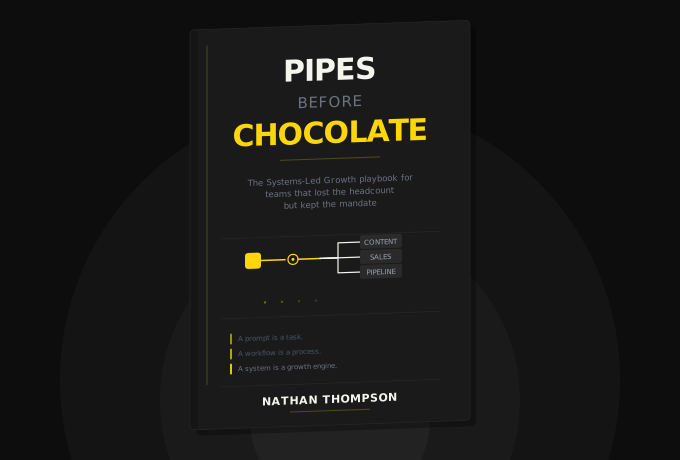

Frequently Asked Questions
A weekly podcast where real SaaS operators share the AI workflows they've built to survive skeleton-crew life. No thought leadership or sponsored hot takes. My goal in each episode is to focus on what's actually working.
Get notified every time we post an new episode
Lorem ipsum dolor sit amet, consectetur adipiscing elit.