One Pager
Template
What they're saying about us

This podcast is a game-changer! The episodes are packed with actionable insights, and the hosts really know how to keep you engaged. I feel like I’m constantly learning something new.
We’ve been recommending Transistor to everyone we know who’s interested in starting a podcast.

I’ve learned so much from this podcast! Whether it’s business, personal growth, or just having fun, every episode feels like time well spent. The perfect blend of entertainment and knowledge. The hosts make complex topics easy.

I’ve been listening since day one, and it just keeps getting better! The production quality is top-notch, and I always walk away with fresh perspectives.
This podcast has transformed my mornings. The hosts dive deep into topics I care about and offer insights I can apply in my life right away. Highly recommend!
After testing out 20+ podcast hosting platforms and working with numerous clients setting up their hosting, Transistor.FM is the one I always recommend because of its unique features, accessibility and user interface.
After testing out 20+ podcast hosting platforms and working with numerous clients setting up their hosting, Transistor.FM is the one I always recommend because of its unique features, accessibility and user interface.
When people ask me which podcast host I recommend, I say: 'Transistor is 100% the way to go.
I’ve been listening since day one, and it just keeps getting better! The production quality is top-notch, and I always walk away with fresh perspectives.

A one pager is the single most useful sales document most companies never create properly. It is the one-page summary that explains who you are, what you do, who you help, and why someone should care. Sales reps send it before calls. Marketing teams attach it to outbound emails. Founders hand it out at conferences. Partners share it internally when evaluating whether to work with you.
And yet most one pagers are either thrown together in Google Docs with no structure, designed in Canva with too much style and not enough substance, or they simply do not exist because nobody had time to make one.
This free one pager template generator gives you a clean, professional, properly structured one pager in minutes. Fill in the fields, pick your brand color, and get HTML you can paste into any document, email, or website.
How the one pager template generator works
Enter your company name, tagline, and website. Then describe who your customer is and what problem they face. Add your solution in one or two sentences. List up to four key benefits, add up to three proof points like stats or case studies, and write your call to action.
Pick an accent color that matches your brand, and the generator builds a formatted one pager with a branded header, structured sections, and a clear CTA at the bottom.
You can copy the output as HTML for web use or as plain text for
documents and emails. The one pager is designed to render correctly in email clients, on websites, and when pasted into Google Docs or Notion.
What makes a good one pager
A good one pager follows a simple structure that answers four questions in order: who are you, what problem do you solve, how do you solve it, and why should I believe you.
The first section establishes who you are. Company name, tagline, and optionally your website. This should take up no more than two lines. If someone cannot understand what your company does from your tagline alone, the tagline needs work before you build the one pager.
The second section frames the problem. This is where most one pagers go wrong. They jump straight to the solution without first making the reader feel the pain. Describe who your customer is and what specific problem they face. Be concrete. Not "businesses struggle with marketing" but "B2B teams with 5 to 15 people are spending $3,000 a month on tools that do not share data."
The third section presents your solution. Keep it to two sentences maximum. Resist the urge to list every feature. A one pager is not a product page. It is a conversation starter. Say what you do, not how every piece of it works.
The fourth section provides proof. This is what separates a one pager that gets read from one that gets dismissed. Stats, case studies, customer quotes, logos, or any concrete evidence that your solution works. Without proof, your one pager is just a claim. With proof, it is a credible proposition.
One pager vs pitch deck vs sales deck
A one pager is not a replacement for a pitch deck or a sales presentation. Each serves a different purpose at a different stage of the buyer journey.
A one pager is for the first touch. It is what you send before a meeting, attach to a cold email, or hand out at a networking event. Its job is to earn the next conversation, not close the deal.
A pitch deck is for the meeting itself. It goes deeper into the problem, solution, product, team, and traction. Its job is to build enough conviction to move to the next step.
A sales deck is for the evaluation stage. It addresses specific buyer concerns, compares against alternatives, and presents pricing. Its job is to help the buyer make a decision.
If your one pager tries to do the work of a pitch deck, it becomes too long and too detailed. If your pitch deck is as sparse as a one pager, it lacks the depth buyers need to move forward. Each document has a lane. Stay in it.
How to use your one pager effectively
The most effective use of a one pager is as a leave-behind. Send it after a conversation so the prospect has something concrete to share with their team. Attach it to a follow-up email with a note like "here is a quick summary of what we discussed."
This gives your internal champion the tool they need to sell your solution to their colleagues who were not in the room.
One pagers also work well as outbound attachments. Instead of a cold email that describes everything you do, send a brief note with the one pager attached. Let the document do the selling. This feels less pushy than a wall of text and gives the prospect something they can scan in 30 seconds.
For conference and event use, have printed copies available but also keep a digital version on your phone. When someone asks what your company does, pull up the one pager and walk them through it. It is faster than a verbal pitch and more memorable than a business card.
Common one pager mistakes
The most common mistake is including too much information. A one pager that is actually two pages defeats its purpose. If you cannot fit your message on one page, you have not refined your message enough. Cut features, cut jargon, cut anything that does not directly serve the four-question structure.
The second mistake is leading with the solution instead of the problem. Buyers do not care what your product does until they feel the pain it solves. Start with the problem every time.
The third mistake is skipping proof. An unsupported claim is just marketing. A claim backed by a specific stat or customer result is evidence. Always include at least one proof point, even if it is early and modest.
The fourth mistake is a weak call to action. "Learn more" is not a CTA. "Book a 15-minute demo" is. Tell the reader exactly what to do next and make it as easy as possible to do it.
Who this tool is for
This one pager template generator is built for founders, sales reps, marketing managers, and anyone who needs a professional one pager without hiring a designer or spending hours in a slide tool. Enter your information, get a clean document, and start using it today.
Pipes Before Chocolate
How to build an AI-augmented go-to-market engine with a skeleton crew, content, sales outbound, inbound, ABM, and thought leadership, without a 15-person team or a six-figure tool budget.
Download for Free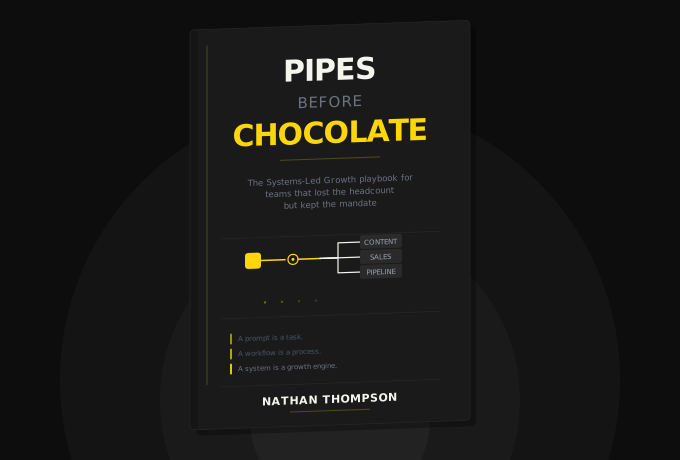

Frequently Asked Questions
A weekly podcast where real SaaS operators share the AI workflows they've built to survive skeleton-crew life. No thought leadership or sponsored hot takes. My goal in each episode is to focus on what's actually working.
Get notified every time we post an new episode
Lorem ipsum dolor sit amet, consectetur adipiscing elit.