How to Run Your
Quality Audit
What they're saying about us

This podcast is a game-changer! The episodes are packed with actionable insights, and the hosts really know how to keep you engaged. I feel like I’m constantly learning something new.
We’ve been recommending Transistor to everyone we know who’s interested in starting a podcast.

I’ve learned so much from this podcast! Whether it’s business, personal growth, or just having fun, every episode feels like time well spent. The perfect blend of entertainment and knowledge. The hosts make complex topics easy.

I’ve been listening since day one, and it just keeps getting better! The production quality is top-notch, and I always walk away with fresh perspectives.
This podcast has transformed my mornings. The hosts dive deep into topics I care about and offer insights I can apply in my life right away. Highly recommend!
After testing out 20+ podcast hosting platforms and working with numerous clients setting up their hosting, Transistor.FM is the one I always recommend because of its unique features, accessibility and user interface.
After testing out 20+ podcast hosting platforms and working with numerous clients setting up their hosting, Transistor.FM is the one I always recommend because of its unique features, accessibility and user interface.
When people ask me which podcast host I recommend, I say: 'Transistor is 100% the way to go.
I’ve been listening since day one, and it just keeps getting better! The production quality is top-notch, and I always walk away with fresh perspectives.

How to Capture What "Good" Looks Like So AI Can Reproduce It
This is the audit most teams skip. It's also the one that matters most for AI output quality.
The content audit tells you what you have. The context audit tells you what you know. The process audit tells you how work flows. The quality audit tells you what the bar is.
Without it, your workflows produce output that's structurally competent and tonally generic. The blog posts have the right sections but don't sound like your brand. The outbound emails are grammatically correct but feel like they could have come from any company. The case studies hit the right beats but lack the specific voice that makes a reader trust you.
The AI isn't the problem. The input is. You never told the system what "good" looks like for you.
The Principle: Good In, Good Out
Every AI workflow is a multiplier. It multiplies whatever you feed it.
Feed it a vague brief with no competitive angle, and it produces a vague article with no competitive angle, just faster. Feed it a detailed brief with a specific ICP pain point, a clear differentiation argument, and a competitive gap to exploit, and it produces a focused article that sounds like it was written by someone who knows the market.
The same principle applies to quality. Feed a workflow generic quality standards ("write in a professional tone") and it produces content that sounds like every other B2B blog on the internet. Feed it an annotated example of your best work, with specific notes on what makes it good and what to avoid, and the output matches your standard.
I learned this building case studies. The first case study I produced with an AI workflow was technically fine and completely lifeless. It had the right structure, the right sections, the right pull quotes. It read like a template.
Then I wrote one by hand. A real case study, with real voice, real specificity, real opinion about why this customer's results mattered. I fed that hand-written version to the workflow as a quality template. The next AI-produced case study was 85% there. The one after that was 90%.
The hand-written example did more for output quality than any amount of prompt engineering.
What to Capture
For every type of output your system will produce, you need one annotated example of excellence. Not a template. Not a format guide. A real piece of finished work that represents the standard, with notes explaining why it's good.
For each output type, get three things:
1. The Example Itself
A real, published (or publishable) piece that represents your quality bar. Not your average output. Your best output. The blog post that got shared. The outbound email that got a reply. The case study that sales actually sends. The one-pager that a prospect commented on.
If you've been producing content for any length of time, you know which pieces are your best work. You might not be able to articulate why, but you know. Pull those pieces. They're your quality templates.
2. Annotations: What Makes It Good
This is where most teams struggle, because articulating why something is good is harder than producing it. But the annotations are what the workflow actually learns from. Without them, the workflow copies surface patterns (length, structure, formatting) and misses the deeper qualities (voice, specificity, opinion, rhythm).
Don't write "good tone." Write "the opening line references a specific pain point the reader is experiencing right now, not a generic industry observation."
Don't write "well-structured." Write "every section leads with the conclusion, then provides supporting evidence. The reader gets the point in the first sentence and the proof in the next three."
Don't write "engaging." Write "uses a real customer quote in the third paragraph that makes the abstract benefit concrete. The quote is nine words and it does more work than the two paragraphs around it."
The more specific the annotation, the more the workflow can reproduce the quality. Vague annotations produce vague improvements.
Here's a practical approach: read your best piece paragraph by paragraph. After each one, write one sentence explaining what that paragraph does well. At the end, you'll have a set of annotations that describe your quality standard in operational terms.
3. Common Mistakes to Avoid
For each output type, what does a bad version look like? What are the patterns that signal mediocrity?
For blog posts, the mistakes might be: opens with a generic industry observation instead of a specific claim.
Uses three parallel examples when one deep example would be stronger. Ends with a summary of what was just said instead of a forward-looking statement. Hedges every opinion with "it depends" or "your mileage may vary." Uses buzzwords instead of the specific thing the buzzword is trying to describe.
For outbound emails, the mistakes might be: leads with the company's credentials instead of the prospect's problem. References the prospect's company by name in a way that feels automated rather than personal. Uses "I hope this finds you well." Asks for "15 minutes of your time" without explaining what the prospect gets from those 15 minutes.
For case studies, the mistakes might be: buries the result in the third paragraph instead of leading with it. Uses generic language like "significant improvement" instead of specific numbers. Doesn't include the customer's own words anywhere. Reads like a product brochure instead of a story about a real company solving a real problem.
The mistakes list is as valuable as the quality example. It gives the workflow a boundary: produce output that looks like this, and never produce output that looks like that.
Which Output Types Need Quality Templates
Every type of content your system produces should have one. Start with the outputs that face your prospects and customers directly.
Blog posts. Highest-volume output for most teams. The quality template should demonstrate your brand voice, your approach to structure, your use of data and examples, and the level of opinion you're comfortable expressing. This is the template that governs your content engine, so it has the most downstream impact.
Outbound emails. The template should show how you personalize beyond "Hi [First Name]," how you connect the prospect's specific situation to your value prop, and how you close with an ask that gives them a reason to respond.
Case studies. The template should show how you frame the customer's problem, present the solution, quantify the results, and use the customer's own language. The difference between a case study that sales shares and one that collects dust is almost always voice and specificity.
One-pagers. The template should show how you balance information density with readability and how you tailor the message to a specific account. One-pagers are often the first document a prospect shares internally with their buying committee, so the quality bar is high.
Follow-up emails (post-call). The template should show how you reference specific moments from the conversation, attach relevant content, and advance the deal. A great post-call follow-up makes the prospect feel heard. A generic one makes them feel processed.
Landing pages. The template should demonstrate headline writing, value prop hierarchy, proof point placement, and CTA design.
Sales talking points. The template should show the level of specificity you expect: not "mention our integration capabilities" but "reference the specific integration relevant to this prospect's tech stack, with a time-to-value estimate."
You don't need all of these on day one. Start with the two or three output types your system will produce first (likely blog posts, outbound emails, and follow-up emails if you're following the 30-day build order). Add quality templates for additional output types as you build those workflows.
Who Produces the Quality Templates
The person who knows what good looks like for each output type.
This isn't always the most senior person. It's the person whose work consistently represents the standard you want the system to reproduce.
For blog posts, it might be the content lead or the best writer on the team. For outbound emails, it might be the top-performing sales rep. For case studies, it might be the product marketer who wrote the one that sales can't stop sharing.
If you're a one-person team, you produce all of them. The good news: you only need one annotated example per output type. The bad news: the example has to be genuinely excellent, not just acceptable.
If you don't have an excellent example for a given output type, write one by hand before you build the workflow. This is the single most important investment you can make in output quality. The first version of everything has to be manual and excellent. Then the system can reproduce the standard.
How the Quality Template Gets Used
The quality template doesn't sit in a document somewhere as a reference for humans. It gets embedded into the workflow itself.
When the content engine generates a draft, the workflow includes the quality template as part of the generation prompt: "Here is an example of a blog post that meets our quality standard. Here are annotations explaining what makes it good. Here are common mistakes to avoid. Generate a draft that matches this standard for the following topic."
When the outbound workflow generates an email, it includes the email quality template: "Here is an example of a high-performing outbound email. Here is what makes it effective. Here is what to avoid. Generate a personalized email for this account that matches this standard."
The quality template becomes a parameter in the workflow, not a separate document. It's referenced every time the workflow runs. This is why the annotations matter so much: they're the specific instructions that steer the AI from "structurally correct" to "actually good."
As your quality standard evolves (and it will, as you learn what works and what doesn't), update the templates. The workflow automatically produces better output the next time it runs because the reference point improved.
The Feedback Loop
The quality audit isn't a one-time event. It's the beginning of a feedback loop.
Month one: you create your quality templates based on your best existing work. The workflows start producing output that's close but not perfect.
Month two: you've reviewed enough AI-produced content to know where the gaps are. The drafts nail the structure but miss the voice in the introduction. The outbound emails get the personalization right but the CTA is too soft. Update the annotations. Add a new mistake to avoid. The next batch is better.
Month three: you've produced a new piece that's better than your original quality template. It was AI-drafted and human-edited, and the final version is stronger than the hand-written original. Replace the template. The bar just went up.
This is how the system compounds. The quality templates improve, which improves the output, which gives you better examples to use as templates. Each cycle raises the standard.
But it only works if someone is paying attention. The moment you stop reviewing output and stop updating templates is the moment quality starts to decay. The AI doesn't know when it's getting worse. You do.
Time Investment
An hour per output type, assuming the right person is available and they already have an example of their best work. If they need to produce the example from scratch, add two to four hours for that first piece.
For a team starting with three output types (blog posts, outbound emails, post-call follow-ups), that's three to four hours. Not a large investment for the single highest-leverage input to your entire system's output quality.
The quality audit is fast. Its impact is permanent, because every piece of content your system produces from this point forward is bounded by the standard you set here.
Set it high.
Pipes Before Chocolate
How to build an AI-augmented go-to-market engine with a skeleton crew, content, sales outbound, inbound, ABM, and thought leadership, without a 15-person team or a six-figure tool budget.
Download for Free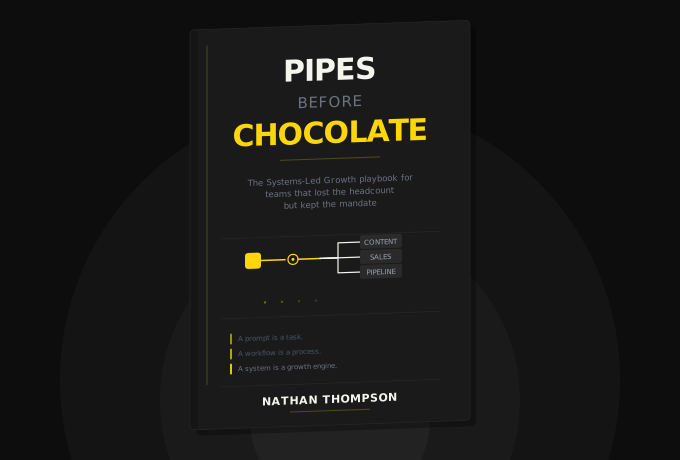

Frequently Asked Questions
A weekly podcast where real SaaS operators share the AI workflows they've built to survive skeleton-crew life. No thought leadership or sponsored hot takes. My goal in each episode is to focus on what's actually working.
Get notified every time we post an new episode
Lorem ipsum dolor sit amet, consectetur adipiscing elit.