How to Run Your
Context Audit
What they're saying about us

This podcast is a game-changer! The episodes are packed with actionable insights, and the hosts really know how to keep you engaged. I feel like I’m constantly learning something new.
We’ve been recommending Transistor to everyone we know who’s interested in starting a podcast.

I’ve learned so much from this podcast! Whether it’s business, personal growth, or just having fun, every episode feels like time well spent. The perfect blend of entertainment and knowledge. The hosts make complex topics easy.

I’ve been listening since day one, and it just keeps getting better! The production quality is top-notch, and I always walk away with fresh perspectives.
This podcast has transformed my mornings. The hosts dive deep into topics I care about and offer insights I can apply in my life right away. Highly recommend!
After testing out 20+ podcast hosting platforms and working with numerous clients setting up their hosting, Transistor.FM is the one I always recommend because of its unique features, accessibility and user interface.
After testing out 20+ podcast hosting platforms and working with numerous clients setting up their hosting, Transistor.FM is the one I always recommend because of its unique features, accessibility and user interface.
When people ask me which podcast host I recommend, I say: 'Transistor is 100% the way to go.
I’ve been listening since day one, and it just keeps getting better! The production quality is top-notch, and I always walk away with fresh perspectives.

How to Extract the Knowledge That Lives in People's Heads (& Put It Where AI Can Use It)
Your content library holds your assets. Blog posts, case studies, one-pagers. But your workflows don't just need content. They need context.
When the outbound system generates a personalized email, it pulls a case study from the library, but it also needs to know your value propositions, your ICP definitions, your competitive positioning, and the specific language that resonates with each persona. When the content engine drafts a blog post, it needs to know what your brand sounds like, what claims you can credibly make, and what differentiates you from the three competitors the prospect is evaluating.
That context currently lives in scattered places. The value props are in a slide deck from last quarter's sales kickoff. The ICP definitions are in a Google Doc that nobody updated. The competitive positioning is in your best rep's head. The product truths are split between the founder's mental model and the marketing site copy, which don't always agree.
The context audit extracts all of that, structures it, and puts it in a format that any workflow can query.
Who to Interview
Three to five people. That's it. You're not running a company-wide survey. You're talking to the people who hold the most concentrated institutional knowledge.
Your best salesperson. Not the newest rep or the most senior one. The one who closes the most deals. They know what actually resonates with buyers, which objections come up every week, and what language makes prospects lean in versus tune out. Their knowledge is built from hundreds of real conversations, and most of it has never been written down.
Your best customer success manager. They know why customers stay and why they leave. They hear the real reasons for renewal and churn, not the reasons customers put in exit surveys. They know which product features customers actually use versus which ones the marketing site highlights.
Your founder or CEO. They hold the original product vision, the competitive positioning that doesn't fit on a slide, and the strategic context that nobody else has. They also tend to hold opinions about positioning that may or may not match what the marketing team has published. Surfacing those gaps now is better than discovering them when a workflow produces content the CEO disagrees with.
Your product lead. They know what the product actually does today, what it doesn't do, what's on the roadmap, and which features have been renamed, deprecated, or rebuilt since the last time marketing updated the website.
Optional: a recent customer. If you can get 30 minutes with a customer who bought in the last six months, their language for describing your product and the problem it solves is often more useful than anything your internal team produces. They speak buyer language, not company language.
The Interview Questions
You don't need a long list. Five questions, asked to each person, will surface 80% of the context your Brand Brain needs.
Question 1: "When you're explaining what we do to someone who's never heard of us, what do you say?"
Ask this to every interviewee. You'll get different answers from each one. That's the point. The salesperson's version will be benefit-focused and buyer-centric. The founder's version will be vision-heavy and differentiation-focused. The product lead's version will be capability-focused. The CSM's version will be outcome-focused.
The gaps and overlaps between these answers are your messaging framework. Where they agree is your core positioning. Where they disagree is where you need to make a decision about what the Brand Brain encodes as truth.
Question 2: "When a customer renews, what's the reason they give?"
This surfaces your real value propositions, not the ones on your website, but the ones customers actually experience. The answer is almost never "because your product has feature X." It's usually something like "because we can't imagine going back to the way we did it before" or "because your team actually helps us solve problems" or "because it saves my team four hours a week on reporting."
Those reasons, in that language, become your value props. Tag each one by persona and use case.
Question 3: "When we lose a deal, what's the reason?"
This is equally important and harder to get honest answers about. Push past "they went with a competitor" to the specific reason. Was it pricing? A feature gap? A trust issue? A bad demo? An internal champion who left? A competitor who positioned better against a specific pain point?
The reasons you lose deals become your objection handling framework. Every outbound workflow needs to know which objections are common so it can proactively address them. Every piece of content should be informed by what's actually preventing deals from closing.
Question 4: "What do customers say about us that surprises you?"
This surfaces positioning opportunities you didn't know you had. Maybe customers describe your product in a way your marketing never considered. Maybe they value a feature your team thinks is minor. Maybe they use your product for a use case you didn't design for.
These surprises are gold for content strategy. They're angles your competitors aren't covering because they're unique to your customer experience.
Question 5: "If you had to describe our ideal customer in one sentence, who is it?"
Force a single sentence. Not a paragraph. Not a list of characteristics. One sentence that captures the person, the problem, and the moment.
"A head of marketing at a Series B SaaS company who just lost two team members and needs to maintain output with half the people."
"A founder who built a great product but has no idea how to get it in front of the right buyers and doesn't want to hire a $200k VP of Marketing to figure it out."
These sentences become the opening lines of your ICP profiles. They're specific enough to picture a real person. If the answer is "mid-market B2B companies," push harder. That's a category, not a customer.
How to Structure the Output
The interview answers need to be structured so workflows can query them, not just so humans can read them. A Google Doc summary is useful for alignment meetings. It's useless for an outbound workflow that needs to match a value prop to an account profile.
Structure the output into four queryable components:
Value Propositions (5-8)
For each value prop:
- Statement: One sentence. What you do for the customer in their language.
- Persona tags: Which buyer personas this resonates with.
- Pain point tags: Which specific problems this addresses.
- Use case tags: Which scenarios this applies to.
- Industry tags: Which verticals this is most relevant for.
- Proof point: The specific data, customer quote, or case study that backs this up. If you don't have a proof point yet, flag it. An unsupported value prop is a liability in outbound content.
ICP Profiles (2-3)
For each persona:
- Role: Job title and functional responsibility.
- Daily reality: What their day actually looks like. What they're managing, what's on their plate, what keeps them up.
- Language: The specific words and phrases they use to describe their problems. Pull these directly from the interviews and from sales call transcripts if you have them.
- Objections: What they push back on during the sales process. Price, complexity, risk, timing, internal politics.
- Success metrics: What outcome would make them a hero internally. Revenue growth? Time saved? Team efficiency? Cost reduction?
- Decision process: Who else is involved. Who has veto power. What internal politics affect the deal.
Competitive Positioning
For each primary competitor (two to four):
- Their positioning: How they describe themselves.
- Real differentiators: Where you actually win, backed by customer evidence or data. Not aspirational claims.
- Where they win: Where they genuinely beat you. Be honest. If your outbound system claims you're better at something a competitor actually does better, a prospect who's evaluated both will lose trust immediately.
- Switching triggers: What causes a customer to leave them and come to you. These are your most effective outbound angles.
Product Truths
- Current feature set: What exists today, with current naming conventions.
- Credible claims: What results you can back up with data. "Saves teams 10 hours per week" is a credible claim if you have customer data to support it. "Revolutionizes your workflow" is not a claim, it's marketing filler.
- What you don't do: Equally important. If a workflow generates content that implies capabilities you don't have, it creates a trust problem that sales has to clean up.
Common Mistakes
Capturing marketing language instead of customer language. If your salesperson says "clients tell us they can finally keep up" and you write it down as "enables operational efficiency gains," you've lost the most valuable part. Write it down the way they said it. The customer language is what makes AI output feel like it was written by someone who understands the reader.
Treating the output as a one-time document. The context audit produces the first version of your Brand Brain's messaging and ICP layers. It's not done. It needs to be updated every quarter as your product evolves, your competitive landscape shifts, and your sales team learns new things from real conversations.
Interviewing too many people. Five is the ceiling, not the floor. Three is often enough. Each additional interview adds diminishing returns and significantly more time structuring the output. Start with three. Add more only if you identify specific gaps.
Skipping the competitive positioning. Teams avoid this because it requires honesty about where competitors win. That honesty is exactly what prevents your workflows from producing content that gets challenged by informed prospects. If your outbound email claims superiority on a dimension where you're actually weaker, the prospect who's done their homework will dismiss everything else you say.
Time Investment
Five to six hours total. Three to four hours of interviews (45 minutes to an hour per person, three to five people). Two hours structuring the output into the queryable format described above.
The structuring step is where most teams cut corners.
They do the interviews, write up notes in a Google Doc, and call it done. That doc is useful for humans but invisible to workflows. The extra two hours of structuring, tagging each value prop by persona and use case, writing ICP profiles with queryable fields, documenting competitive positioning with honest differentiators, is what makes the difference between a Brand Brain and a meeting summary.
Features section
Lorem ipsum dolor sit amet, consectetur adipiscing elit. Suspendisse tincidunt sagittis eros. Quisque quis euismod lorem. Etiam sodales ac felis id interdum.

Lorem ipsum dolor sit amet, consectetur adipiscing elit. Suspendisse tincidunt sagittis eros.

Lorem ipsum dolor sit amet, consectetur adipiscing elit. Suspendisse tincidunt sagittis eros.

Lorem ipsum dolor sit amet, consectetur adipiscing elit. Suspendisse tincidunt sagittis eros.
Lorem ipsum dolor sit amet, consectetur adipiscing elit. Suspendisse tincidunt sagittis eros.

Amet minim mollit non deserunt
Amet minim mollit non deserunt

Amet minim mollit non deserunt
Amet minim mollit non deserunt


Slideshow gallery section title goes here
Lorem ipsum dolor sit amet, consectetur adipiscing elit. Suspendisse tincidunt sagittis eros. Quisque quis euismod lorem.
Pipes Before Chocolate
How to build an AI-augmented go-to-market engine with a skeleton crew, content, sales outbound, inbound, ABM, and thought leadership, without a 15-person team or a six-figure tool budget.
Download for Free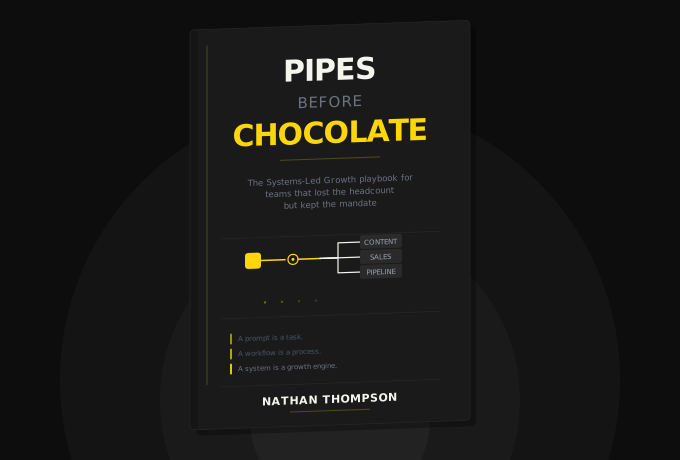

Frequently Asked Questions
A weekly podcast where real SaaS operators share the AI workflows they've built to survive skeleton-crew life. No thought leadership or sponsored hot takes. My goal in each episode is to focus on what's actually working.
Get notified every time we post an new episode
Lorem ipsum dolor sit amet, consectetur adipiscing elit.