Your Brand Brain
Setup Guide
What they're saying about us

This podcast is a game-changer! The episodes are packed with actionable insights, and the hosts really know how to keep you engaged. I feel like I’m constantly learning something new.
We’ve been recommending Transistor to everyone we know who’s interested in starting a podcast.

I’ve learned so much from this podcast! Whether it’s business, personal growth, or just having fun, every episode feels like time well spent. The perfect blend of entertainment and knowledge. The hosts make complex topics easy.

I’ve been listening since day one, and it just keeps getting better! The production quality is top-notch, and I always walk away with fresh perspectives.
This podcast has transformed my mornings. The hosts dive deep into topics I care about and offer insights I can apply in my life right away. Highly recommend!
After testing out 20+ podcast hosting platforms and working with numerous clients setting up their hosting, Transistor.FM is the one I always recommend because of its unique features, accessibility and user interface.
After testing out 20+ podcast hosting platforms and working with numerous clients setting up their hosting, Transistor.FM is the one I always recommend because of its unique features, accessibility and user interface.
When people ask me which podcast host I recommend, I say: 'Transistor is 100% the way to go.
I’ve been listening since day one, and it just keeps getting better! The production quality is top-notch, and I always walk away with fresh perspectives.

How to Build the Knowledge Layer That Makes AI Sound Like You
Every AI workflow you build will pull from somewhere. The question is whether it pulls from a structured, consistent source of truth or from whatever scattered documents your team happens to have lying around.
Right now, your company's institutional knowledge lives in scattered places. The value props are in a slide deck from last quarter's sales kickoff. The ICP definitions are in a Google Doc that the VP of Marketing wrote and nobody updated. The brand voice guidelines are in a PDF that the agency delivered eighteen months ago. The product positioning is in the CEO's head.
When a workflow pulls from scattered inputs, it produces scattered outputs. The outbound email references a value prop that was retired six months ago. The blog post uses product language from last year's naming convention. The ABM landing page makes a claim your product can't support.
The Brand Brain fixes this.
What the Brand Brain Is
A Brand Brain is a structured, queryable knowledge layer that holds everything your team and your workflows need to operate with a consistent understanding of who you are, what you sell, who you sell it to, and what "good" looks like.
It extends beyond a content library. A content library holds your assets: blog posts, case studies, quote cards, competitive positioning docs. The Brand Brain holds the context that makes those assets coherent: your messaging framework, your ICP definitions, your brand voice, your product truths, your quality standards, and your process documentation.
When the Brand Brain exists, every workflow in the system and every tool your team builds on top of it inherits the same foundation. The outbound email references the right value props. The blog post matches the brand voice. The ABM landing page uses the correct product positioning. The case study extracts the proof points that align with your actual claims.
Nothing drifts, because everything pulls from the same source.
Why This Matters Now
There's a wave coming that makes this urgent.
Team members are building their own custom tools with Claude, ChatGPT, Cursor, and similar platforms. A sales rep builds a tool to generate follow-up emails. A marketing manager builds one to draft social posts. A product marketer builds one to create competitive positioning docs.
Each tool is smart. Each tool is fast. And each tool encodes a slightly different understanding of your brand.
Marketing's tool says one thing. Sales' tool says another. The customer sees both.
Without a Brand Brain, every custom tool fragments your go-to-market. With one, every tool starts from the same foundation. This isn't about slowing down the power users or speeding up the beginners. It's about building the layer underneath both of them.
The Six Components
1. Messaging Framework
Your core value propositions, tagged by persona, pain point, use case, and industry.
These are the same value props that feed your outbound system and your ABM campaigns, stored in a structured format that any workflow can query. Not a paragraph of marketing copy, but discrete propositions that can be assembled in different combinations depending on the context.
Write five to eight core value propositions. For each one, tag it with which persona it resonates with, which pain point it addresses, which use case it supports, and which industries it applies to.
When the outbound system generates an email for a healthcare prospect concerned about data fragmentation, it queries the Brand Brain and pulls the value prop tagged "healthcare + data fragmentation." The email is specific because the system has specific inputs.
2. ICP Definitions
Detailed profiles of your target personas. Not the two-sentence descriptions from your website. Real profiles that include their roles, their daily problems, the language they use, the objections they raise, and the outcomes they care about.
Build these from real conversations. Interview your best salesperson, your best customer success manager, and your founder. Ask them:
- When you explain what we do to someone who's never heard of us, what do you say?
- When a customer renews, what's the reason they give?
- When we lose a deal, what's the reason?
The answers become your ICP profiles. Write them with the customer's language, not marketing language. If your buyers say "we can't keep up with all the tools" instead of "tech stack consolidation challenges," use their words. Those words are what make AI outputs feel like they were written by someone who understands the reader.
Structure each profile so a workflow can match an enriched lead against the right persona and pull the right messaging automatically.
3. Brand Voice and Tone
Annotated examples of what your content should sound like and what it shouldn't.
This is the difference between AI output that sounds like your brand and AI output that sounds like everyone else. You need two things:
1. Good examples. Three to five pieces of content that represent your voice at its best. Annotate each one: what makes the tone right, what specific choices (sentence length, level of formality, use of data, willingness to state opinions) define your voice.
2. Bad examples. Three to five pieces that represent what your content should never sound like. Annotate each one: what makes it wrong, what patterns to avoid. If your voice is direct and opinionated, a bad example might be a hedge-filled paragraph that says nothing. If your voice is technical and precise, a bad example might be a buzzword-heavy marketing paragraph.
The good and bad examples together form the quality benchmark that every content workflow references. Without them, AI drafts are structurally competent and tonally generic. With them, AI drafts match your brand.
4. Product Truths
What your product actually does. What claims you can back up with data. What features exist, what they're called (the current names, not last year's names), and what results customers have actually achieved.
This prevents the common failure where AI-generated content makes claims your product can't support. It also prevents the subtler failure where content references a feature by a name that was changed three months ago.
Update this every time the product ships something new, renames something, or discontinues something. If you don't, your workflows will confidently produce content with outdated product information.
5. Quality Standards
For each type of output your system produces (blog posts, outbound emails, case studies, landing pages, one-pagers), what does "good" look like?
Identify the person on your team who knows what good looks like for each output type. Have them produce one annotated example: here's a good one, here's what makes it good, here's a common mistake to avoid.
These become quality templates. The content engine doesn't produce good output because the AI is smart. It produces good output because you gave it an example of what "good" looks like and it uses that example as its benchmark.
Without the quality template, the output is competent. With it, the output matches your standard.
6. Process Documentation
How each department's workflows actually operate at a granular level. Not the org chart version. The real, daily version.
How does a blog post go from idea to published? How does a sales rep prepare for a call? What happens when an inbound lead submits a form?
This documentation does two things. First, it tells you which processes should be workflows (the defined ones, where the steps are the same every time) and which might eventually support agentic capabilities (the ones that require judgment between steps). Second, it becomes the foundation that tells anyone building a new tool how their tool connects to what everyone else is doing.
Where to Store It
The Brand Brain doesn't need to be fancy. It needs to be structured, queryable, and maintained.
Options I've used or seen work:
Supabase. Postgres database with a clean API layer. This is what I use. Every workflow queries it directly. Simple to set up, scales well, and the SQL access lets you run complex queries when you need to analyze coverage or identify gaps.
Notion. A well-organized Notion workspace with linked databases can serve as a Brand Brain for smaller teams. The search is weaker than a real database, but the ease of maintenance is higher.
What doesn't work: Google Drive folders, Confluence pages nobody reads, or a shared document that lives in someone's bookmarks bar. If it's not structured and queryable, it's not a Brand Brain. It's just documentation.
How to Build It: The Four Audits
Before you can fill the Brand Brain, you need to know what exists, what's missing, and where the institutional knowledge currently lives. I recommend spending two to three days on four audits before you touch a single workflow.
The Content Audit (half a day to a full day). Inventory every piece of content worth keeping. For each asset: Is it still accurate? Does it reflect current product and positioning? Is it good enough to reference? Tag everything that passes the filter by persona, buying stage, topic cluster, pain point, and industry.
The Context Audit (five to six hours). Interview three to five people: best salesperson, best CSM, founder, product lead. Capture value props, ICP profiles, competitive positioning. Structure the output so it's queryable, not just readable.
The Process Audit (a few hours per department). Map how work actually flows. Where are the handoffs? Where are the bottlenecks? Where does the same work get done twice? This becomes your process documentation layer and tells you what to automate first.
The Quality Audit (an hour per output type). For each content type your system produces, get one annotated example of excellence from the person who knows what good looks like.
Every shortcut you take in the audit phase shows up as a quality problem in the production phase. The most common reason AI systems produce bad output is that they were built on incomplete inputs.
The Maintenance Reality
The Brand Brain requires ongoing maintenance. This isn't optional.
Tags drift. Someone tags a blog post as "awareness" when it's really "consideration." Another person uses "RevOps" while someone else uses "Revenue Operations." Over six months, the taxonomy gets messy, queries return less relevant results, and the system's intelligence degrades. Fix this by enforcing a controlled vocabulary: define the exact tags allowed in each category. No synonyms, no variations. "Revenue Operations" not "RevOps." "Healthcare" not "Health" or "Medical."
Content goes stale. A case study references a product feature that's been renamed. A competitive positioning document cites a competitor's pricing that changed last quarter. Schedule quarterly content reviews. Spend one day per quarter reviewing the library for outdated information.
The library grows unmanageable. After a year of producing content at volume plus case studies plus repurposed thought leadership plus event derivatives, you have thousands of assets. Sunset old content deliberately. Move outdated pieces to archive status so they don't get surfaced by workflows but remain accessible if someone specifically needs them.
Track content freshness as a metric. What percentage of your library has been reviewed or updated in the last six months? Below 70%, your library is decaying. Above 90%, you're maintaining it well.
Total maintenance: about four to six hours per month for a library of 500 to 1,000 assets. That's real time. But a system that people don't trust doesn't get used. And a system that doesn't get used is just a folder with better tagging.
What Happens When It Works
Let me trace one example through a connected system.
Day 1. A sales rep has a call with a prospect at a mid-market healthcare company. The post-call workflow processes the transcript and extracts key themes: the prospect is concerned about data fragmentation, they're evaluating a competitor, and their team has been reduced from eight to three people. The tagged insights get stored in the Brand Brain under the relevant descriptors.
Day 3. The content engine is generating blog posts. The strategy brief targets "data fragmentation in healthcare." The workflow queries the Brand Brain and finds the tagged insight from the sales call. The draft incorporates the specific language the prospect used to describe the problem, because that language is now in the system.
Day 7. The ABM system assembles a personalized landing page for the prospect's company. It queries the Brand Brain for healthcare proof points and finds a case study from a similar company, a quote card from a healthcare customer, and the blog post from Day 3, which was informed by the prospect's own words.
Day 14. The prospect has a second call. They say, "I read that blog post about data fragmentation. It described exactly what we're dealing with."
The rep isn't surprised. The blog post was built from the prospect's own words.
That's a connected system. One conversation became an insight, which became content, which became a personalized page, which became a second conversation where the prospect felt understood.
None of that happens if the brand knowledge is sitting in a slide deck from last quarter.
The Litmus Test
Content utilization rate: What percentage of the library's assets have been shared, referenced, or surfaced by a workflow in the last 90 days?
Below 40%: you have a findability problem or a relevance problem.
Above 60%: the system is working.
Above 80%: your content strategy is exceptionally well-aligned with your go-to-market.
If you're below 40%, the issue is almost always one of two things: the content isn't structured well enough to be surfaced (a tagging problem), or the content doesn't match what the team actually needs (a strategy problem). Both are fixable. Both start with the Brand Brain.
Pipes Before Chocolate
How to build an AI-augmented go-to-market engine with a skeleton crew, content, sales outbound, inbound, ABM, and thought leadership, without a 15-person team or a six-figure tool budget.
Download for Free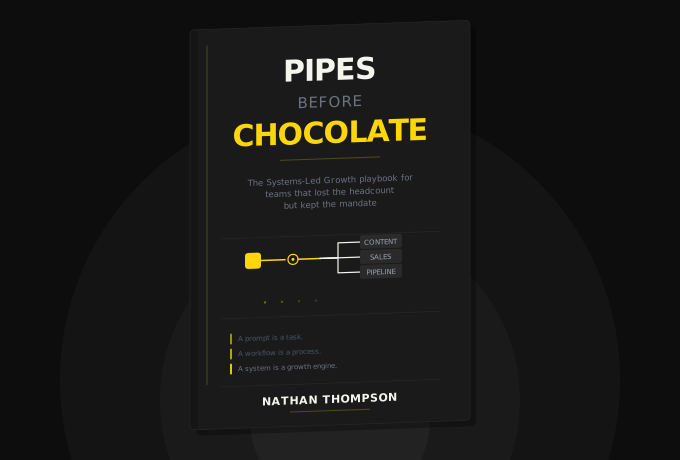

Frequently Asked Questions
A weekly podcast where real SaaS operators share the AI workflows they've built to survive skeleton-crew life. No thought leadership or sponsored hot takes. My goal in each episode is to focus on what's actually working.
Get notified every time we post an new episode
Lorem ipsum dolor sit amet, consectetur adipiscing elit.