FAQ Template
Generator
What they're saying about us

This podcast is a game-changer! The episodes are packed with actionable insights, and the hosts really know how to keep you engaged. I feel like I’m constantly learning something new.
We’ve been recommending Transistor to everyone we know who’s interested in starting a podcast.

I’ve learned so much from this podcast! Whether it’s business, personal growth, or just having fun, every episode feels like time well spent. The perfect blend of entertainment and knowledge. The hosts make complex topics easy.

I’ve been listening since day one, and it just keeps getting better! The production quality is top-notch, and I always walk away with fresh perspectives.
This podcast has transformed my mornings. The hosts dive deep into topics I care about and offer insights I can apply in my life right away. Highly recommend!
After testing out 20+ podcast hosting platforms and working with numerous clients setting up their hosting, Transistor.FM is the one I always recommend because of its unique features, accessibility and user interface.
After testing out 20+ podcast hosting platforms and working with numerous clients setting up their hosting, Transistor.FM is the one I always recommend because of its unique features, accessibility and user interface.
When people ask me which podcast host I recommend, I say: 'Transistor is 100% the way to go.
I’ve been listening since day one, and it just keeps getting better! The production quality is top-notch, and I always walk away with fresh perspectives.

Every website needs an FAQ section. Very few have one that actually works for SEO.
The difference between an FAQ section that sits on your page and one that earns rich results in Google comes down to one thing: structured data. Specifically, FAQ schema markup in JSON-LD format that tells search engines exactly which questions your page answers and what those answers are.
Most teams skip the schema because it requires writing JSON by hand or paying a developer to do it. This free FAQ template generator solves both problems. Enter your questions and answers, and it gives you two outputs: a clean, formatted HTML FAQ section you can paste into any website, and the JSON-LD schema markup ready to copy directly into your page code.
How the FAQ template generator works
Add your questions and answers using the form. You can add as many as you need. When you click generate, the tool creates two things simultaneously.
The first is a styled HTML FAQ section with clean typography, proper heading hierarchy, and a layout that works on any website. Copy the HTML and paste it into your CMS, whether that is WordPress, Webflow, Shopify, Squarespace, or anything else that accepts custom HTML.
The second is the JSON-LD schema markup wrapped in a script tag. This is the code that tells Google your page contains FAQ content. Copy it and paste it into the head or body of the same page where your FAQ section appears. In WordPress, use a Custom HTML block or a plugin like Rank Math. In Webflow, use a Custom Code Embed or the page-level custom code settings. In Shopify, add it to your theme.liquid file.
Why FAQ schema markup matters for SEO
FAQ schema markup can trigger rich results in Google search. Instead of showing just your page title and meta description, Google may display your questions and answers directly in the search results. This expanded listing takes up more visual space on the page, pushes competitors further down, and gives searchers an immediate reason to click through to your site.
Pages with FAQ rich results typically see higher click-through rates than pages without them because the expanded format catches the eye and demonstrates that your page has specific, relevant answers to the searcher's question.
Beyond traditional search, FAQ content structured with proper schema also improves your visibility in AI search. AI-powered answer engines like ChatGPT, Perplexity, and Google's AI Overviews look for clearly structured question-and-answer content when generating responses. Well-formatted FAQ sections with schema markup are easier for these systems to parse, cite, and surface in their answers.
What makes a good FAQ section
The best FAQ sections answer real questions that real people ask, not questions you wish they would ask. Start by looking at the questions your sales team hears most often, the queries showing up in your Google Search Console, and the questions competitors answer on their websites.
Each answer should be concise but complete. Aim for two to four sentences per answer. If an answer requires more detail, write a brief summary for the FAQ and link to a dedicated page that covers the topic in depth. This creates internal linking opportunities while keeping the FAQ section scannable.
Avoid using your FAQ section as a sales pitch. Questions like "Why is our product the best?" followed by a promotional paragraph will not earn rich results and will not build trust with readers. Answer questions honestly and practically. The credibility you build is worth more than the pitch you wanted to make.
How many FAQs should a page have
Google does not set a hard limit on FAQ schema, but practical experience suggests that five to ten questions per page performs best. Fewer than five and the section feels thin. More than ten and it becomes a wall of text that readers scroll past.
If you have more than ten questions worth answering, consider splitting them across multiple pages organized by topic. A pricing page should have pricing FAQs. A product page should have product FAQs. A blog post should have FAQs related to the specific topic covered. This approach is better for SEO because each page targets a focused set of questions rather than trying to answer everything at once.
Common FAQ schema mistakes
The most frequent mistake is adding FAQ schema to a page that does not visibly display the FAQ content. Google requires that the questions and answers in your schema match content that is visible to users on the page. Hidden FAQs or schema-only content without a matching FAQ section can result in a manual action or loss of rich results.
The second mistake is using FAQ schema for content that is not actually a question and answer. Product features, testimonials, and step-by-step instructions have their own schema types. Using FAQ schema for non-FAQ content dilutes its effectiveness and may confuse search engines about the purpose of your page.
The third mistake is duplicating the same FAQ schema across multiple pages. Each page should have unique questions relevant to that specific page's content. Copying the same FAQ block across your entire site does not help and may hurt your SEO.
FAQ schema and AI search optimization
As AI-powered search engines become a larger share of how people find information, FAQ content takes on additional importance. AI models like GPT, Claude, and Gemini are trained to recognize question-and-answer patterns. When your page has clearly structured FAQ content with proper schema, AI systems can more easily identify, extract, and cite your answers in their responses.
This is the intersection of traditional SEO and answer engine optimization. FAQ schema gets you visibility in Google. Well-written, structured FAQ content gets you cited by AI. Doing both puts you in front of your audience regardless of how they search.
Who this tool is for
This FAQ template generator is built for content marketers, SEO managers, website owners, and anyone who wants to add a professional FAQ section to their website with proper schema markup and does not want to write JSON by hand. It works with any website platform and takes less than two minutes to generate both outputs.
Pipes Before Chocolate
How to build an AI-augmented go-to-market engine with a skeleton crew, content, sales outbound, inbound, ABM, and thought leadership, without a 15-person team or a six-figure tool budget.
Download for Free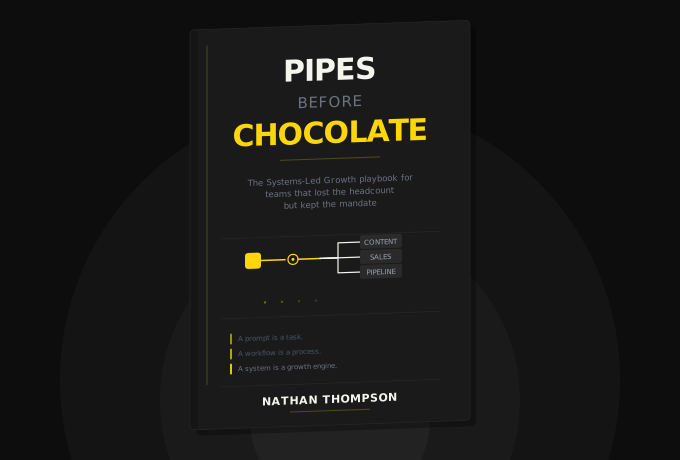

Frequently Asked Questions
A weekly podcast where real SaaS operators share the AI workflows they've built to survive skeleton-crew life. No thought leadership or sponsored hot takes. My goal in each episode is to focus on what's actually working.
Get notified every time we post an new episode
Lorem ipsum dolor sit amet, consectetur adipiscing elit.